
Electric vehicles claimed a record 10.5% share of the U.S. auto market in Q3 2025 — and that single statistic tells only a fraction of the story. The real transformation happening inside America's garages, on its highways, and above its cities is far more sweeping. Future mobility car design trends are no longer science-fiction concept sketches gathering dust at auto shows. They are rolling off production lines, landing in driveways, and, in some cases, lifting off rooftops. From AI-defined cockpits to carbon-neutral manufacturing, the next generation of vehicle design is rewriting every assumption Americans hold about what a car is, does, and looks like. This article explores the six most consequential automotive design trends shaping U.S. transportation through 2030 — and what they mean for everyday drivers.
1. The Rise of the Software-Defined Vehicle
Software-defined vehicles (SDVs) are cars where the core functionality — driving dynamics, safety systems, infotainment, and energy management — is governed by software rather than fixed hardware. This is the single most disruptive shift in automotive design history, and it is happening right now.
Honda's upcoming 0 Series (launching in North America in 2026) is built on a philosophy the company calls "thin, light, and wise." At its core sits ASIMO OS, an in-house operating system developed from Honda's robotics research, which manages everything from drive systems to Level 3 autonomous driving features. Crucially, new capabilities will be delivered over time through OTA (over-the-air) software updates — just like a smartphone. The car you buy in 2026 will be meaningfully different by 2028, without a dealer visit.
This approach is reshaping exterior and interior design alike. When a vehicle's "brain" can be upgraded remotely, designers are freed from building every feature into fixed hardware. Instrument clusters, control interfaces, and even driving modes become reconfigurable. The industry has coined a new term — the "AI-defined vehicle" — to reflect how deeply artificial intelligence now penetrates vehicle platforms, from engineering and testing to real-time in-cabin personalization.
For American drivers, this means the human-machine interface (HMI) is evolving faster than any previous automotive technology. Voice-driven commands, predictive navigation, and adaptive driver profiles are becoming baseline expectations, not premium add-ons.
2. Aerodynamic and Minimalist Exterior Design
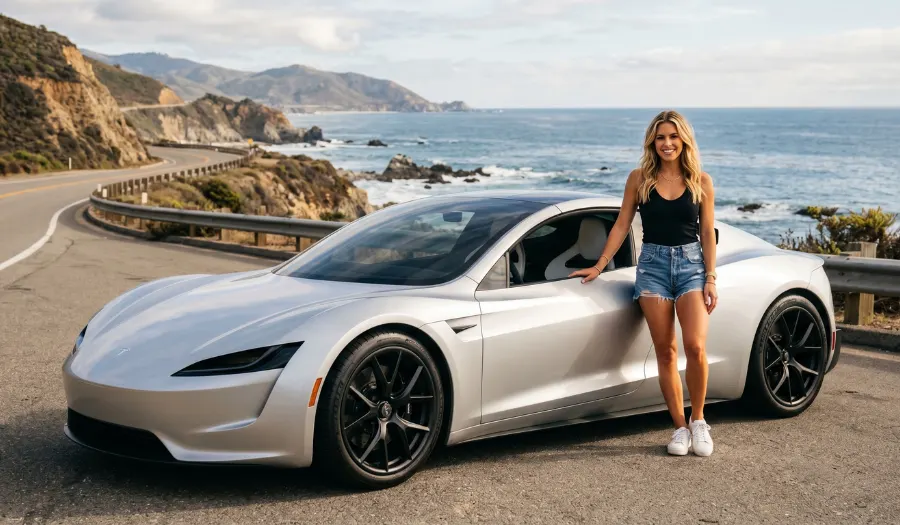
Walk past a 2030 concept car and you may not immediately recognize it as a car at all. Future mobility car design trends in exterior aesthetics are converging on one principle: form follows aerodynamic function.
Panel gaps — the visible seams between body panels — are being eliminated. Flush door handles retract entirely into body surfaces. Headlight clusters dissolve into seamless LED signatures that wrap around the car's face like a single luminous line. The Mercedes-Benz VISION AVTR concept demonstrates this philosophy at its most extreme: 33 multi-directional bionic flaps replace traditional body panels, responding dynamically to driving conditions and driver input.
On the engineering side, by-wire chassis systems — where steering and braking are controlled electronically rather than mechanically — are moving from premium vehicles into mainstream production. The Tesla Cybertruck and Mercedes-Benz EQS already use steer-by-wire and brake-by-wire elements, and electro-mechanical brakes are scheduled to debut in North American vehicles in 2026. By removing mechanical linkages, designers gain freedom to reimagine the entire front-end architecture, enabling dramatically lower hood lines and wider, more planted stances.
The result is a new generation of EVs that are not just electric — they are aerodynamically optimized in ways gasoline-powered vehicles could never achieve, contributing directly to range efficiency and reduced charging frequency.
3. Reinvented Interiors — Biophilic, Screen-Dominant, and Deeply Personal
Step inside a 2026 flagship EV and you will find a space that feels more like a luxury living room than a traditional cockpit. Next-gen car interiors are undergoing the most dramatic redesign in automotive history, driven by three converging forces: the disappearance of mechanical controls, the dominance of large digital displays, and a growing consumer desire for biophilic design — interiors that incorporate natural textures, organic shapes, and living materials.
Physical gauge clusters have all but vanished. The Porsche 911 (992.2 generation) is among the last holdouts, dropping its analog instrument cluster in its 2025/2026 refresh. In its place: wide-format digital canvases, ambient lighting ecosystems, and in premium concepts, holographic and augmented-reality displays that project contextual information into three-dimensional space around the driver.
At the same time, automakers are responding to consumer fatigue with cold, screen-heavy environments. Cadillac's ultra-luxury Celestiq uses hand-selected natural materials alongside its digital interfaces. Startups and legacy brands alike are experimenting with recycled textiles, sustainably harvested wood, and even mycelium-based foam as interior surface materials. This is biophilic car design in practice — technology and nature coexisting.
Social-media-influenced personalization is also accelerating. Younger American buyers expect their vehicle's ambient lighting, display themes, seat configurations, and even sound profiles to reflect their individual identity — and automakers are building customization engines to deliver exactly that.
4. Sustainable Materials and Eco-First Manufacturing
The future of automotive design is not just about what moves the vehicle — it is about what the vehicle is made of. Sustainable car materials are now a competitive differentiator, not merely a regulatory compliance checkbox.
Ultra-high-strength and hot-stamped steels are enabling greater component integration with meaningful weight reduction — a critical advantage when every kilogram directly impacts EV range. Carbon-fiber composites continue to gain ground in structural applications, supported by advances in bio-based resins that reduce manufacturing emissions. Meanwhile, magnesium thixomolding — in which Chinese manufacturers are now global leaders — offers new flexibility for complex lightweight components.
On the factory floor, Volvo and BMW are constructing climate-neutral manufacturing plants powered entirely by renewable energy. GM's Factory Zero in Detroit is already operating as a model for Industry 4.0 sustainable production, using AI-powered systems to minimize waste and predict maintenance needs before failures occur.
For U.S. consumers, sustainable manufacturing carries direct value: vehicles built on lighter platforms charge faster, accelerate more efficiently, and carry lower total lifecycle emissions — making eco-first design a practical benefit, not just an environmental statement.
5. Aerial and Modular Mobility — The Next Frontier
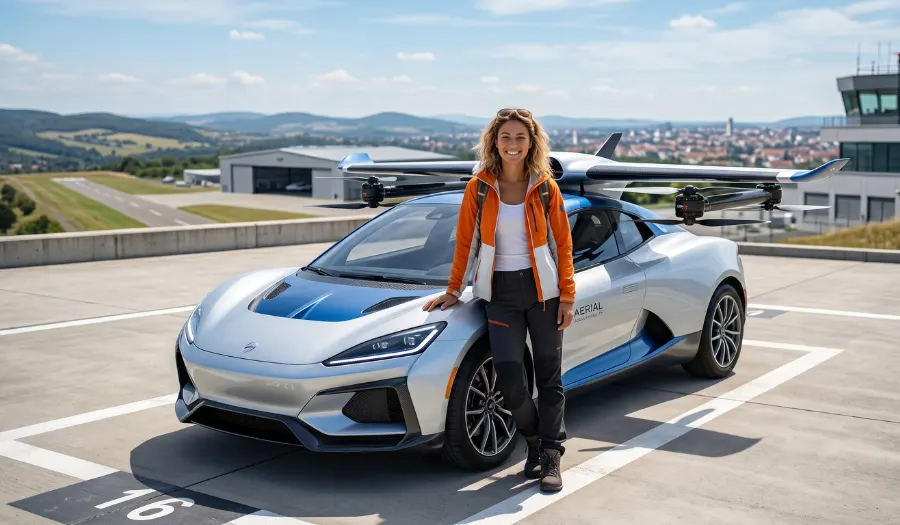
Perhaps no future mobility trend is more visually striking than the emergence of vehicles designed to leave the road entirely. Urban air mobility (UAM) is graduating from concept renderings to limited commercial production, and its design language is influencing ground-based vehicles in return.
The XPeng AeroHT Voyager X2 represents the state of the art: a carbon-fiber passenger pod with eight rotors on four foldable arms, capable of vertical takeoff and landing (VTOL). Its design philosophy — eliminate every gram of non-functional material, wrap the occupant in the safest possible shell, and optimize every surface for aerodynamic efficiency — is a pure expression of function-first future car design.
On the ground, modular vehicle platforms are enabling a new class of configurable mobility. A single electric skateboard platform can underpin a delivery van, a passenger SUV, or a performance coupe — with different bodies swapped according to need. This modularity is transforming how automakers think about design investment: instead of engineering a unique platform per model, they engineer one flexible architecture and dress it differently.
For American cities grappling with congestion, the long-term promise of aerial mobility — personal air vehicles navigating above gridlocked highways — represents a genuine third dimension of transportation design.
6. What These Trends Mean Specifically for American Drivers
Several of these developments carry particular significance for the U.S. market. Honda's 0 Series will debut first in North America. The Infiniti Q70 EV, expected to be priced between $65,000 and $74,000, targets American luxury buyers seeking a domestic alternative to European EV flagships.
On the policy front, right-to-repair legislation is gaining momentum in U.S. states as automakers increasingly lock vehicle systems behind proprietary software. BMW's recently patented fastener system — requiring a brand-specific tool for certain repairs — exemplifies the tension between automaker ecosystem control and consumer ownership rights. American lawmakers are paying attention.
The shift away from Apple CarPlay by GM, BMW, Audi, Volvo, and Polestar is creating a fragmented in-car connectivity landscape that will directly affect how tens of millions of American drivers interact with their vehicles daily. Whether integrated first-party systems or third-party platforms ultimately win is one of the most consequential user-experience battles in the U.S. auto market.
Conclusion
The future of mobility car design in America is not a single trend — it is a convergence. Software-defined architectures are making vehicles perpetually upgradeable. Aerodynamic minimalism is making them more efficient and more beautiful simultaneously. Biophilic interiors are making them more humane. Sustainable materials are making them lighter and greener. Aerial concepts are making them capable of dimensions of travel we have never commercially accessed before.
For American drivers, the next five years will bring vehicles that are smarter, more personalized, and more environmentally responsible than anything previously available at scale. The brands and designers who understand that the car is no longer just a machine — but a connected, adaptive, living extension of its owner's identity — will define the next era of American driving.
Frequently Asked Questions
What are the biggest future mobility car design trends for 2025–2030?
The most significant trends include software-defined vehicle architecture, aerodynamic minimalist exteriors, biophilic and screen-dominant interiors, sustainable lightweight materials, and the emergence of aerial mobility concepts. AI integration across every system — from manufacturing to in-cabin experience — ties all of these together.
How is AI changing automotive design?
AI is influencing car design at every level: generative design tools help engineers create stronger, lighter structures; AI-defined vehicle platforms enable real-time personalization; and machine learning powers advanced driver-assistance systems (ADAS) and Level 3 autonomous driving features being introduced in 2026 models.
What materials are used in future car designs?
Future vehicles increasingly use ultra-high-strength steel, carbon-fiber composites with bio-based resins, magnesium thixomolded components, and sustainable recycled textiles for interiors. These materials reduce weight, improve safety, and lower the vehicle's overall environmental footprint.
What does "software-defined vehicle" mean for car buyers?
A software-defined vehicle (SDV) receives new features, performance improvements, and safety updates via over-the-air (OTA) updates — similar to a smartphone. This means your vehicle can improve after purchase without requiring a dealership visit, and automakers can roll out new capabilities continuously over the vehicle's lifetime.